On the outskirts of Europe’s towns, pipes and chimneys still mark the skyline. This skyline tells a story of prosperity built on steel, paper, chemicals, and many other European businesses. These factories remind us of a model that has long been linear: source materials, process them, sell the products, and dispose of the residues. That imperfect process has powered local economies for decades, but it is no longer sustainable.
In recent years, industries have started to test a different logic. Instead of treating production waste as a burden or cost, some companies now pass it on as a resource or business opportunity. Surplus heat from one plant can feed an industrial process in another factory. By-products can become resources. Energy and water systems can be optimised by sharing. This practice is known as industrial symbiosis (IS). It is promising, but still needs wider recognition.
The IS2H4C project takes IS further. The project works on creating Hubs for Circularity, places where industry, utilities, municipalities, and citizens are all connected. It not only focuses on resource or infrastructure sharing, but also addresses governance, digital tools, and engagement with broader society. In short, it aims to turn industrial clusters into circular systems that serve both production and the communities around them.
The Dutch Hub Connecting Industry and Village through Hydrogen
In the Dutch region of Twente, a group of companies share resources and infrastructure with the nearby village of Aadorp. The IS2H4C project is using this setup to test how hydrogen can support both industry and residential areas.

Hydrogen is produced from renewable electricity (solar and wind) and piped directly into homes in Aadorp to replace natural gas. At the same time, this clean hydrogen is transported to crematoria crematorium, helping them reduce their environmental footprint. A smart energy storage system helps keep the supply steady. There’s more: the oxygen produced during hydrogen generation is sent to a wastewater treatment plant, improving water purification. That treated water is then reused in the hydrogen production process, creating a close loop mechanism.
By linking industry, utilities, and the local village in one system, the Twente hub shows how circular resource use can reach beyond factory walls and become part of daily life.
The German Hub Turning Emissions into E-Fuels
Frankfurt’s Industriepark Höchst is one of Europe’s largest chemical and pharmaceutical complexes. In IS2H4C, it serves as a test site for transforming industrial emissions into valuable chemicals and fuels.
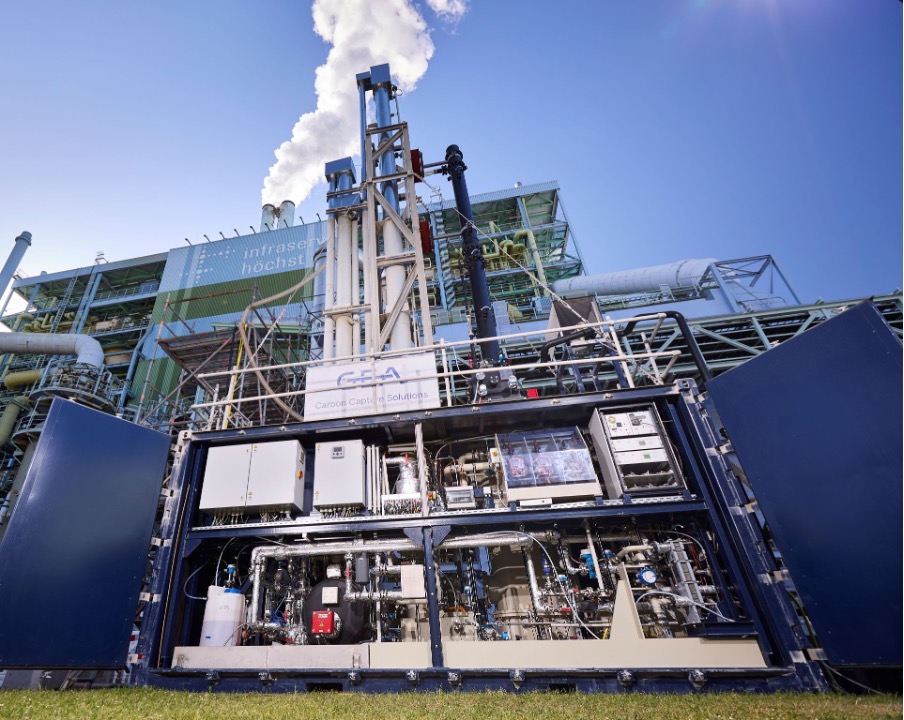
The pilot project focuses on two key components: carbon dioxide captured from a waste incineration plant that generates process steam for the site’s industrial facilities, and hydrogen produced via electrolysis or, in the future, supplied through a dedicated pipeline. These two inputs are combined to create chemicals, plastics, or e-methanol – a synthetic fuel capable of replacing fossil-based resources across various industries. What makes this especially significant is that all of this takes place within an already active, multi-sector industrial park. The hub demonstrates that clean technologies can be integrated into existing sites without major disruption, linking energy, emissions, and production into a new kind of circular flow.
Through this initiative, the Frankfurt hub explores how long-established industrial parks can embed climate solutions into their daily operations – making cleaner production a natural part of doing business.
The Basque Hub Building Circular Chains Across Heavy Industry
The Basque Country hosts some of Spain’s most traditional and energy-intensive industries, including oil refining, steel, paper, and lime production. These sectors are often isolated, but IS2H4C and its Basque initiative, the “Basque Industrial Hub 4 Circularity (BIH4C)” connects them through circular solutions. The BIH4C demonstrates how collaboration can drive sustainability in heavy industry regions.
- Carbon Capture and Methanation in the Lime Sector
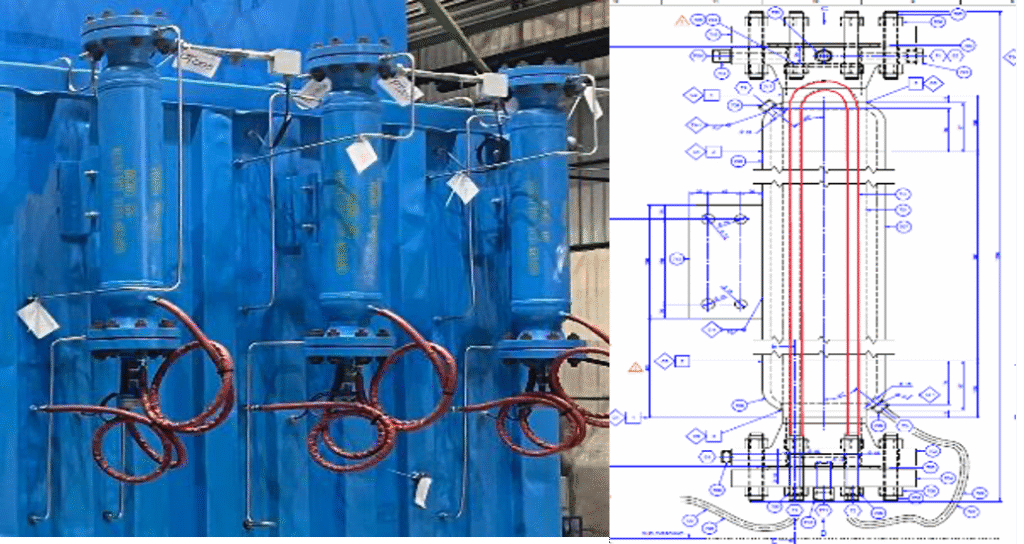
Captured CO₂ is being explored for its potential to produce synthetic fuels through methanation, a process that combines carbon dioxide with hydrogen from renewable sources to obtain methane, a versatile energy carrier that can reduce dependence on fossil fuels. In the lime sector, Pressure Swing Adsorption, polymeric membranes, and multichannel reactor technologies have been developed and integrated into a single prototype.
- Hydrogen Oxy-Fuel Combustion for Ladle Preheating
In the steel sector, trials are underway to apply oxy-combustion and hydrogen burners for ladle preheating — technologies with strong potential to cut emissions while improving energy efficiency in high-temperature processes. At SIDENOR, a new burner has been installed, and initial O₂ and H₂ tests have been successfully completed.
- Carbon Capture and Carbonation of Steel Slags
The lime and steel industries are advancing carbon capture solutions adapted to their production processes, aiming to cut emissions and reuse captured CO₂ in the carbonation of steel slags. This innovative process transforms waste slags into valuable secondary raw materials, supporting circularity in the steel sector. Initial laboratory tests have been performed at SBS facilities, and a portable reactor will be installed in Q4 2025 at CALCINOR to test carbonation rates using real flue gases and produce new construction products.


The Turkish Hub Linking Refining with Appliances
Near the Aegean coast, the Izmir-Manisa region brings together oil refining and appliance manufacturing. IS2H4C uses this mix to explore how captured carbon can be reused in surprising ways.
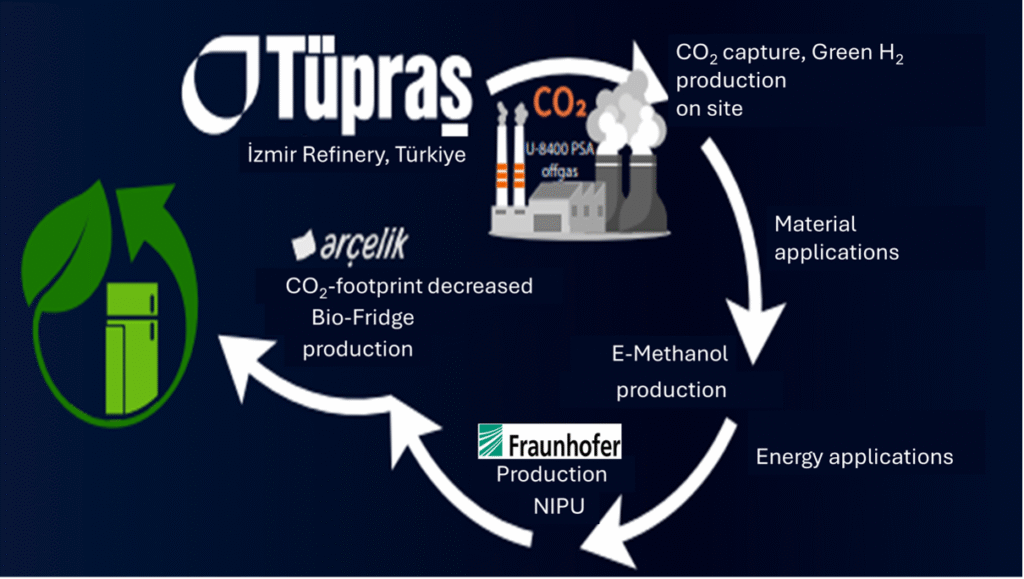
First, hydrogen made by electrolysis from clean electricity is combined with carbon dioxide captured from refining to produce e-methanol on-site. This fuel can be used across several industries, replacing fossil-based inputs. In the Turkish Hub, that same produced e-methanol is used to produce non-isocynate polyurethane, which goes into refrigerators made in the region, reducing the environmental impact of both the process and the product.
This hub connects emissions from heavy industry with the production of household goods. It’s a direct example of how circular thinking can link energy, chemicals, and consumer products into one system.
Beyond the Pilots
The four hubs are connected through a digital collaboration platform. This platform manages information on resources, technologies, and infrastructures, and embeds decision-support tools to help identify and manage exchanges .
IS2H4C also studies business models, regulatory barriers, and ways to build acceptance and trust among citizens and local actors. These dimensions ensure that the project’s technological demonstrations can be replicated and sustained beyond the pilots.
Looking Ahead
IS2H4C shows that circularity is not a single technology or policy. It’s a way of rethinking how regions function. By linking heavy industry, local infrastructure, and social actors into shared systems, the project makes the circular economy tangible and testable.
Each hub offers a unique take on what this can look like in practice. Together, they form a living laboratory for Europe’s transition. The pilots may be local, but the lessons reach far beyond.