Dear Readers,
Over the past months, IS2H4C has continued to move firmly into implementation. Across the project, efforts are increasingly focused on bringing together technological innovation, viable business approaches and societal considerations. From strategic exchanges with the Advisory Board to hands-on developments in Living Labs and new research outputs, the emphasis is clear: making Hubs for Circularity work in real conditions.
Coming up
Matchmaking Workshops from the Türkiye Hub
The Türkiye Hub is organising a matchmaking workshop, designed to connect stakeholders and identify new opportunities for industrial symbiosis. The initiative will take place in May. The session will focus on bringing together key regional actors to exchange needs, resources and ideas, laying the groundwork for concrete circular collaborations. Further activities from other IS2H4C hubs will follow in the coming months, as similar formats are rolled out across the network.
Stay in the loop for updates and upcoming opportunities to engage.
Looking back
Advisory Board Meeting: Shaping the Next Phase
The second IS2H4C Advisory Board meeting provided an important moment for reflection and forward planning. Bringing together external experts from different fields, the discussion centred on recent progress and the priorities for the next phase of the project.
What became evident is that the transition towards circular industrial systems cannot rely on technology alone. While technical developments are advancing, equal attention must be given to economic feasibility and societal integration. The Advisory Board highlighted the need to further strengthen the links between these dimensions, ensuring that circular hubs are not only technically sound but also investable and socially grounded.
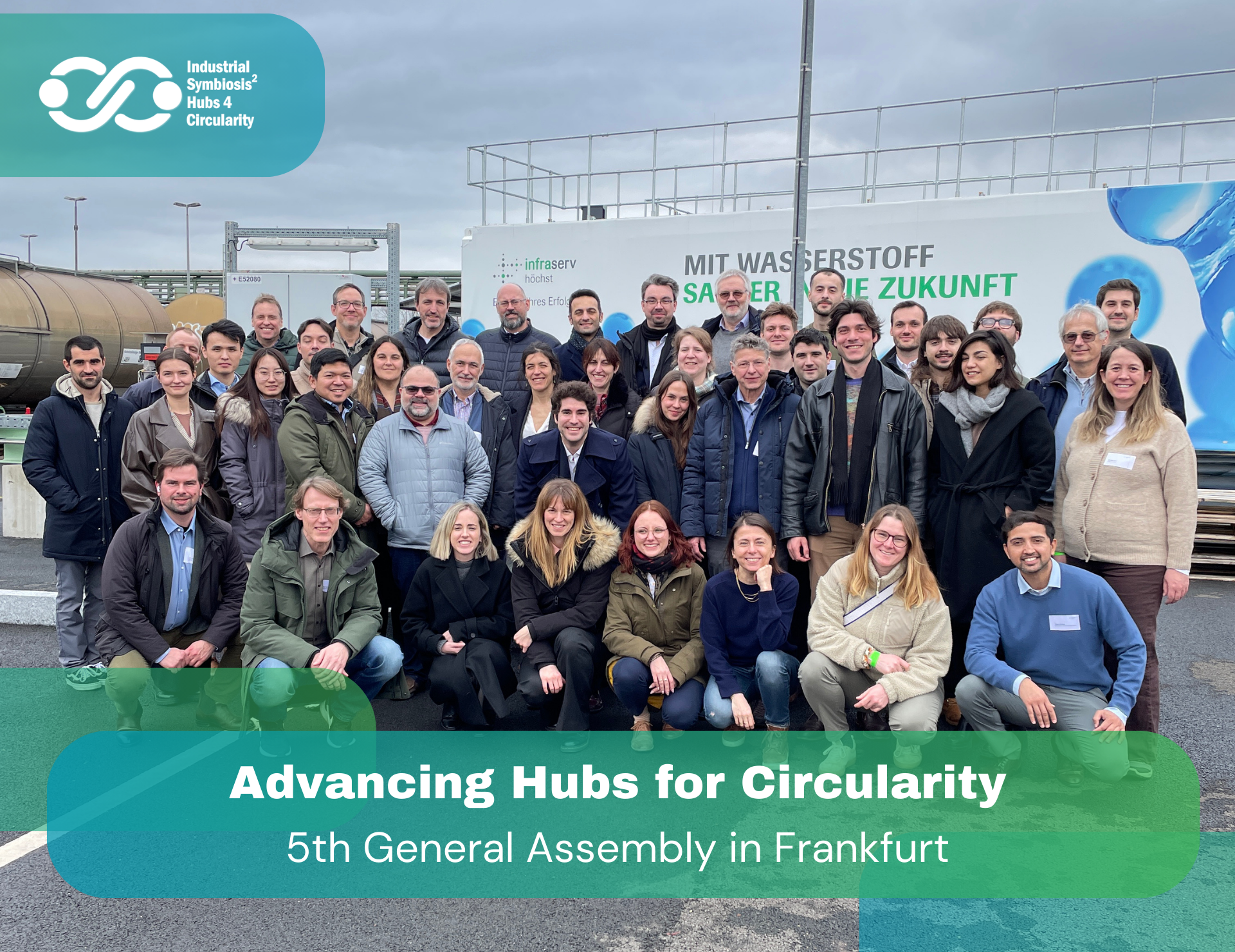
5th General Assembly in Frankfurt
The consortium gathered in Frankfurt, Germany, for its 5th General Assembly, focusing on how project concepts translate into practice. Discussions moved beyond high-level frameworks and into the realities of implementation across work packages.
Key exchanges addressed the deployment of CO₂ capture and utilisation pathways, the development of business models that can sustain cooperation beyond project funding, and the integration of social innovation into industrial transformation. Questions around trust featured prominently in conversations on investment and collaboration, particularly where a lack of trust continues to act as a barrier to progress. At the same time, partners advanced work on Digital Twin technologies and reflected on the AI and environmental ethics-related Implications in IS2H4C.
A visit to Industriepark Höchst, an industrial site in operation since the 19th century, offered a direct view into a highly complex and diverse ecosystem of process industries where several IS2H4C components are being tested. The experience highlighted the challenges of implementing circular solutions within long-established infrastructures, while also reinforcing their tangible potential in such a multifaceted environment.
Living Labs: Testing Circularity on the Ground
Across IS2H4C, Living Labs are now actively translating concepts into regional action, each addressing specific local challenges.
In Germany, two Living Lab workshop sessions focused on the societal dimension of industrial transformation. The first session made it clear that social acceptance is not a secondary issue but a central condition for success. Participants examined public perceptions of industrial projects, recurring conflict lines, and the influence of trust and transparency on local decision-making.
The second session shifted towards practical approaches. Discussions explored how participatory processes can be designed, how perceived risks can be addressed constructively, and what makes dialogue between industry and civil society effective. Drawing on experiences from IS2H4C and related initiatives, the workshops highlighted that industrial de-fossilisation and symbiosis must be developed in close interaction with society if they are to be viable.
In the Netherlands, the Living Lab in Almelo officially launched, bringing together municipalities, researchers, industry representatives and energy partners. The initiative focuses on linking digital innovation with real territorial challenges. By combining local energy data, simulation tools and stakeholder input, the Living Lab supports decision-making around hydrogen developments in Aadorp and broader industrial and urban symbiosis opportunities. At the same time, it lays the groundwork for a regional Local Green Deal in Twente, based on collaboration and long-term commitment.
Parallel activities in the Basque region, Germany and Türkiye show that all Living Labs are now progressing, each adapting the Hubs for Circularity concept to its own regional context.
Understanding the Human Factor
The importance of people, networks and relationships was further highlighted during the Hubs4Circularity Community of Practice webinar held in January 2026. The session focused on stakeholder dynamics within industrial symbiosis and industrial-urban symbiosis projects.
Insights from IS2H4C demonstrated how stakeholder networks evolve over time, what drives or hinders collaboration, and how methods such as social network analysis and regional input–output modelling can support a better understanding of these dynamics. The discussion reinforced that managing relationships and information flows is just as critical as developing technical solutions.
Learn more>>
Latest publications
Digital Collaboration as an Enabler of Industrial Symbiosis
A long-standing barrier in industrial symbiosis is the lack of structured digital collaboration. In the paper “Hubs for Circularity: Reference Architecture of Digital Collaboration Platforms”, the authors propose a model for Digital Collaboration Platforms tailored to the needs of circular industrial hubs. The work outlines how digital environments can support multi-stakeholder interaction, align platform functionalities with real symbiosis challenges, and enable coordination across the full lifecycle of industrial exchanges.
By moving beyond fragmented tools towards integrated systems, this research contributes to closing a critical gap between concept and implementation in industrial symbiosis.
Read more>>
Artificial Intelligence–Driven and Digital Practices
How can digitalisation make circular systems viable and scalable? This question sits at the core of this research.
The paper “Artificial Intelligence–Driven and Digital Practices for Circular Business and Finance: Insights for Advancing Hubs for Circularity” explores how artificial intelligence (AI) and digital technologies can enable the transition from circular business models to Hubs for Circularity (H4Cs). Based on a systematic literature review, it identifies how AI supports value creation, risk reduction, and financial decision-making in industrial symbiosis and related systems.
Key contributions include a value creation framework and a four-phase transition pathway, showing how digitalisation, stakeholder collaboration, and innovative finance mechanisms can scale circular ecosystems. The study highlights AI as a critical enabler for making H4Cs operational, investment-ready, and resilient.
Expanding the Scope of Energy Management
Another recent IS2H4C publication takes a closer look at energy management within circular hubs. The paper “A conceptual framework for sustainable energy management modelling in hubs for circularity” argues that current approaches remain too narrow.
Rather than focusing solely on energy flows, the authors propose integrating material exchanges and waste sharing dynamics into energy system modelling. This shift reflects the broader logic of Hubs for Circularity, where energy, materials and industrial processes are increasingly interconnected. It also points towards new coordination challenges that require both technical and organisational solutions.
From Atoms to Allies: Understanding Collaboration in Circular Hubs
Collaboration in circular systems is shaped by how actors are connected. This study takes a closer look at those relationships.
“From Atoms to Allies: Social Network Analysis of Information and Resource Exchange in Hubs for Circularity” maps how stakeholders exchange information and resources, and how these patterns influence outcomes. Rather than focusing on individual actors, it highlights the structure of networks as a key factor in enabling or limiting cooperation.
It provides a more precise view of what drives effective collaboration in industrial symbiosis.
Stakeholders at the Core of Circularity
Stakeholder engagement is not a one-off exercise but an ongoing condition for progress.
In “Stakeholder engagement in hubs for circularity in Europe”, the authors examine how industry, policy, academia and society interact across four European hubs. The analysis shows that sustained collaboration depends on active participation, supported by governance structures that enable alignment and continuity.
By addressing barriers such as regulatory uncertainty, investment risks and public acceptance, the paper grounds the discussion in real implementation challenges.
Explore all IS2H4C publications in one place on our website.
Thank you for being part of our journey!
Don’t forget to follow us on social media, and visit our website to stay up to date with our progress!
Warm regards,
The IS2H4C Team