Can heavy industrial regions truly become circular, resilient and climate-neutral, building on existing infrastructure and cutting-edge sustainable technologies? What does it take to align technological innovation, business models, governance and financial schemes, and society around that transformation?
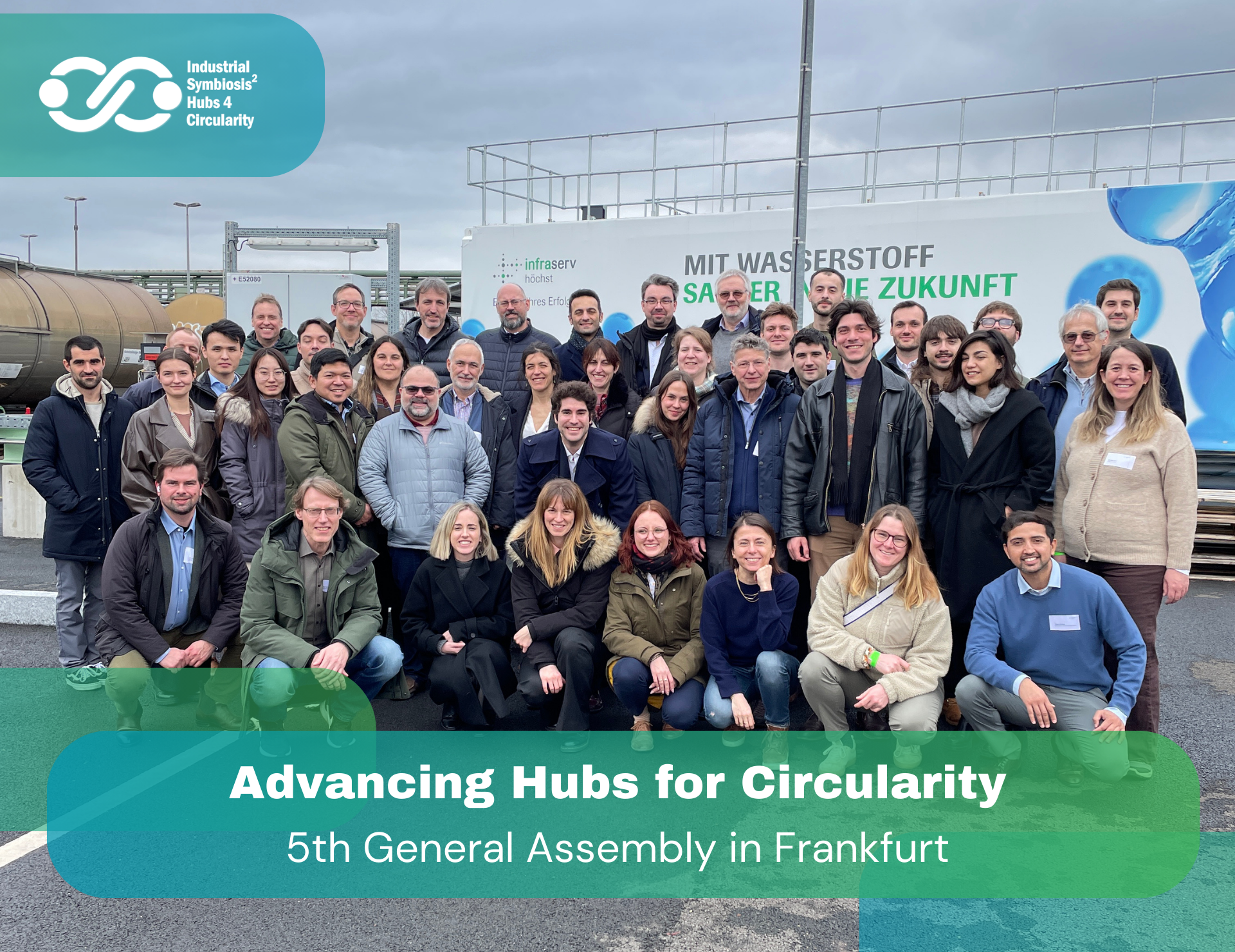
These questions framed the 5th IS2H4C General Assembly, held on 24–25 February 2026 and hosted by Infraserv at Industriepark Höchst.
Now halfway through the project, the consortium came together to assess progress and define the next implementation steps across the four Hubs for Circularity in the Netherlands, Germany, the Basque country, and Türkiye.
More Than Presentations
The General Assembly was a combined structured with presentations about advancements and several workshops. Many work packages moved beyond reporting and used the time to work through open questions, test and validate developed tools, and align on next steps.
Discussions covered:
- Integration and demonstration activities within the hubs
- Embedding societal engagement and governance into hub development
- Refining business and financial models linked to hub synergies
- Modelling trust and understanding its influence on circular cooperation
- Advancing the Digital Collaboration Platform and Digital Twin tools
- Addressing AI and environmental ethics in industrial transformation
Several sessions were designed as co-creation workshops, enabling partners to collectively shape upcoming deliverables and tools rather than review finished outputs.
The discussion raised several thought-provoking questions that are essential for advancing circular hubs:
Are we integrating non-technological elements early enough?
Do our business models reflect real industrial incentives?
How do we ensure digital tools serve as decision-support systems?
And how can trust be meaningfully modelled in simulation frameworks?

Midterm Focus: Integration and Scalability
IS2H4C was conceived to scale industrial areas through systemic change. At midterm, technological deployment is progressing, but the emphasis is shifting towards integration across layers and preparing for replication.
The second half of the project will focus on consolidating results, strengthening cross-work package alignment and ensuring that the four hubs function as coherent, transferable models.
Next Step: Advisory Board Meeting
To help our project development, IS2H4C will engage its Advisory Board on March 11th. Their independent perspective will provide additional input on strategic direction, scalability, and long-term impact.
IS2H4C gratefully acknowledges Infraserv for hosting the General Assembly and fostering an open and collaborative working atmosphere. The transition from industrial symbiosis to operational Hubs for Circularity will continue.